Print on Demand Journals, Planners & More
Print on demand journals are printed and shipped only when a customer orders, so you can sell custom notebooks, planners, calendars, and greeting cards with no inventory and no minimum order. The value sits in the cover design and the interior layout — not in written chapters — which makes stationery one of the quickest print-on-demand categories to enter.
This guide maps the whole stationery family, the interior layouts that define each product, the best providers, how KDP and Etsy margins differ, and how to make journal files that print cleanly.
The print on demand stationery family
"Journals" is the entry point to a much bigger category. Once you can design a cover and an interior, the same skill spans notebooks, planners, calendars, greeting cards, and low-content books — so one aesthetic can become a whole product line.
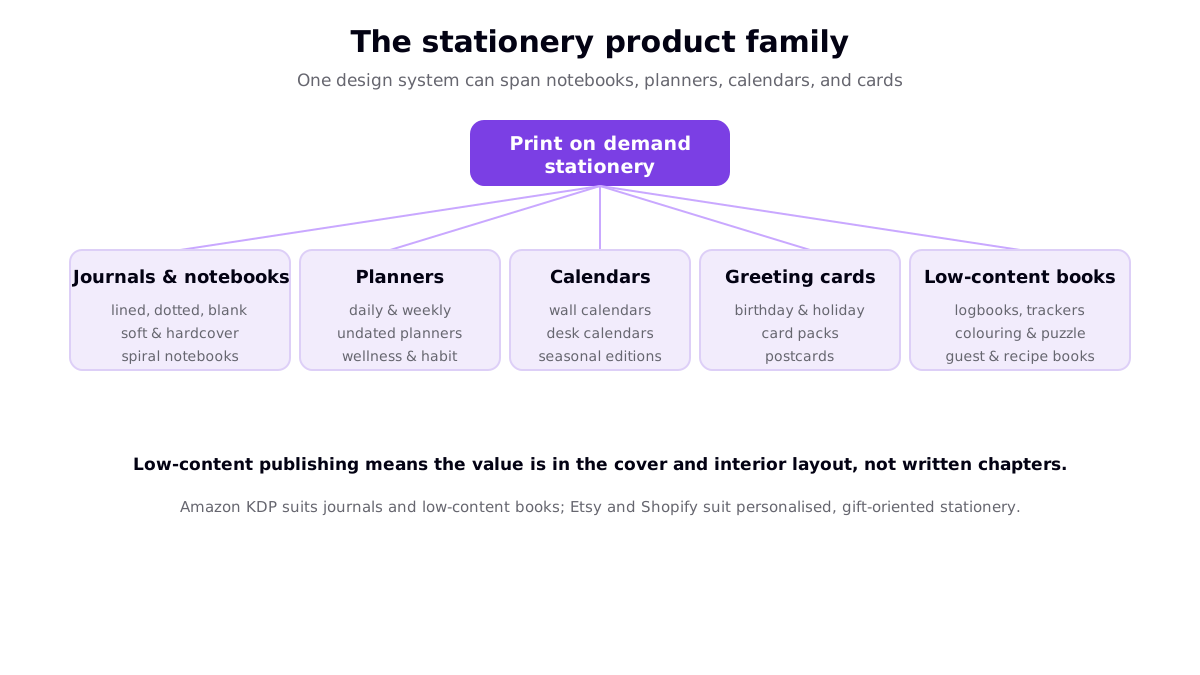
Most of these are low-content books: printed books whose pages are mostly blank or templated. Because there is no manuscript to write, they are far faster to produce than a traditional book, which is exactly why they suit print on demand.
Interior layouts define the product
The single decision that turns a cover into a specific product is the interior page template. The same cover becomes a bullet journal, a productivity planner, or a writer's notebook depending on what is inside.
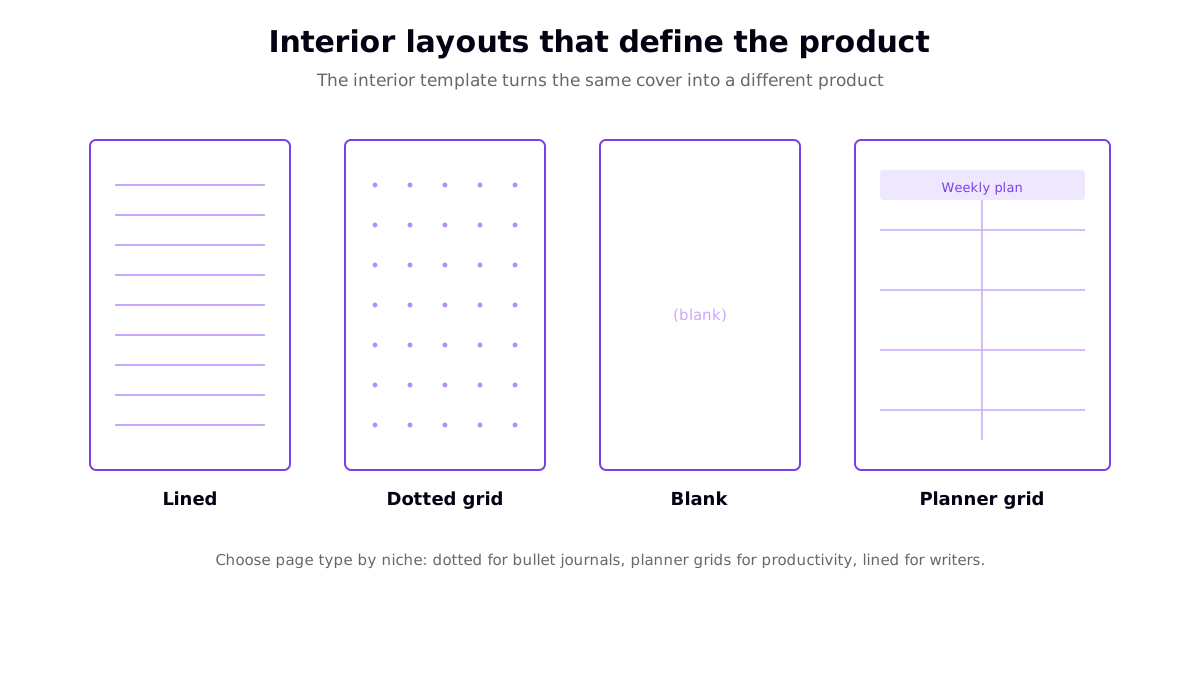
- Lined — the default for writers and general journaling.
- Dotted grid — the bullet-journal favourite; flexible for lists, layouts, and sketching.
- Blank — for sketchbooks and freeform creativity.
- Planner grids — daily, weekly, and undated layouts for productivity and wellness niches.
Best print on demand journal providers
Where you sell largely decides which provider fits. Store and marketplace providers offer physical variety and personalisation; Amazon's KDP offers reach.
| Provider | Strength | Best for |
|---|---|---|
| Amazon KDP | Prints on demand into Amazon's marketplace | Low-content books & journals with built-in traffic |
| Printify | Spiral, hardcover, and softcover notebooks, low base cost | Etsy and store sellers wanting variety |
| Printful | Softcover spiral and hardcover journals, branding options | Consistent quality and white-label packaging |
| Lulu | Notebooks, journals, and planners with no minimums | Shopify direct sales and branded stationery |
| Gooten | Hardcover and 5"×7" journal options | Adding journals to a broader catalogue |
Because binding, paper, and print quality vary, order a sample before you scale a design. For distributing full books rather than journals, see our guide to print on demand books, and for the wider platform landscape, the best print on demand companies.
Where the margin lives: KDP vs Etsy
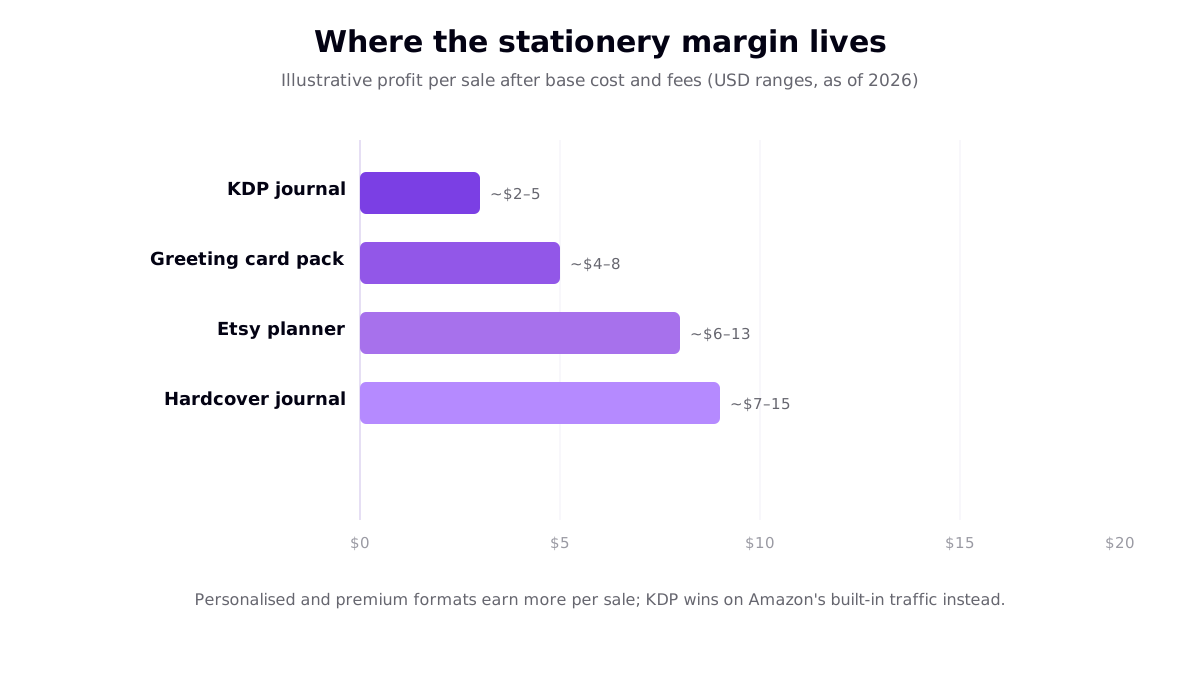
Stationery margins depend heavily on format and channel. Personalised and premium products earn the most per sale; Amazon KDP earns less per unit but hands you traffic you would otherwise have to buy.
| Channel | Upside | Trade-off |
|---|---|---|
| Amazon KDP | Huge built-in search traffic; ideal for low-content books | Modest per-unit royalty; limited personalisation |
| Etsy | Higher prices, personalised & giftable stationery | You compete for and drive the traffic |
| Your own store | Best margins and full brand control | You bring 100% of the traffic |
These are illustrative ranges, as of 2026 — actual numbers depend on page count, format, and where you sell. A common playbook is to list evergreen journals on KDP for reach and reserve personalised or premium stationery for Etsy and your own store. For the marketplace mechanics, our Etsy print on demand guide and Amazon print on demand guide go deeper.
Journal and planner niche ideas
- Wellness & self-care — gratitude journals, habit trackers, mood logs.
- Productivity — daily planners, project logs, undated weekly planners.
- Hobby-specific — recipe books, reading logs, garden journals, travel diaries.
- Occupational — teacher planners, nurse logbooks, small-business trackers.
- Gift & personalised — named journals for birthdays, graduations, and holidays.
As always, specificity wins. A "notebook" competes with everything; a "2026 marathon training log" competes with almost nothing and speaks directly to a buyer.
Making journal files print-ready
Journals have two files: the cover and the interior. Follow your provider's exact template dimensions, which include bleed and, for paperbacks, a spine width that depends on page count. Export the cover at roughly 300 DPI and keep text and logos inside the safe margin so nothing is trimmed. For interiors, embed fonts or flatten to a print-ready PDF so line spacing and grids stay exact. If your cover art comes from an AI generator or a low-resolution source, upscale it to the template's pixel size first — our 300 DPI print-ready guide shows how.
Personalisation and gift stationery
The single biggest lever in stationery margins is personalisation. A blank lined journal competes with millions of others; the same journal with a buyer's name, a date, or a monogram on the cover becomes a gift, and gifts command a premium. Personalised stationery also sidesteps price competition, because a named product is not directly comparable to a generic one.
Practical personalisation ideas that sell well as of 2026:
- Named covers — a first name or monogram turns a stock design into a birthday or graduation gift.
- Dated planners — a specific year or event (wedding, pregnancy, first year of school) adds urgency and relevance.
- Photo books and memory journals — buyers pay for sentiment, so these carry strong margins.
- Greeting cards and card packs — low base cost, high impulse appeal, and easy to bundle into sets.
Etsy and your own store are the natural home for personalised stationery because they support made-to-order options; Amazon's KDP is better kept for evergreen, non-personalised journals and low-content books.
Mistakes to avoid with print on demand journals
- Ignoring the interior. A beautiful cover with the wrong page layout for the niche will disappoint buyers and earn poor reviews. Match the interior to what the customer actually wants to do inside the book.
- Skipping the proof. Binding, paper brightness, and spine alignment look different in print than on screen. Order a physical sample before you scale.
- Designing one product in isolation. Build a small system — a cover style that works across a journal, a planner, and a card pack — so one aesthetic becomes several listings.
- Using unlicensed art or fonts. Covers built from stock art or fonts you are not licensed to sell commercially can get a listing removed. Use original or properly licensed assets.
How to start
Pick one niche and one interior layout, design three or four covers, and list them where the niche shops. Watch which covers get views and sales, then expand the winners into more sizes and adjacent formats — a bestselling gratitude journal becomes a matching planner, a card pack, and a wall calendar. One strong stationery aesthetic, reused across formats, beats a scattered catalogue every time.
Frequently asked questions
What are the best print on demand journal providers?
For journals sold on your own store or Etsy, Printify, Printful, Gooten, and Lulu are common choices, offering softcover, hardcover, and spiral notebooks with no minimum order. For journals and low-content books sold on Amazon, Kindle Direct Publishing (KDP) is the default because it prints on demand and taps Amazon's built-in traffic. Many sellers use both — KDP for reach and a store provider for personalised or premium versions.
Are print on demand journals profitable?
They can be, because base costs are low and buyers pay for a nice cover and a useful interior. Margins are strongest on personalised and premium formats such as hardcover journals and Etsy planners, while KDP journals earn less per unit but benefit from Amazon's traffic. The category also rewards repeat buyers and seasonal collections.
What is a low-content book?
A low-content book is a printed book whose pages are mostly blank or templated rather than full of written chapters — journals, notebooks, planners, logbooks, and trackers. The value is in the cover design and the interior page layout, which makes low-content books far quicker to create than a traditional manuscript and a natural fit for print on demand.
Should I sell journals on Amazon KDP or Etsy?
Amazon KDP gives you enormous built-in search traffic and is ideal for low-content books and journals, but per-unit royalties are modest and personalisation is limited. Etsy and your own store let you charge more, offer personalised and premium formats, and control branding, but you must bring the traffic. Many sellers list evergreen journals on KDP and reserve personalised or giftable stationery for Etsy.